
The thing that set my choice in stone was my visit to Christ’s during an open day. I loved the college, especially the atmosphere inside it and the people studying and working here. After that trip, I knew that this was the place I wanted to spend the next four years of my life.
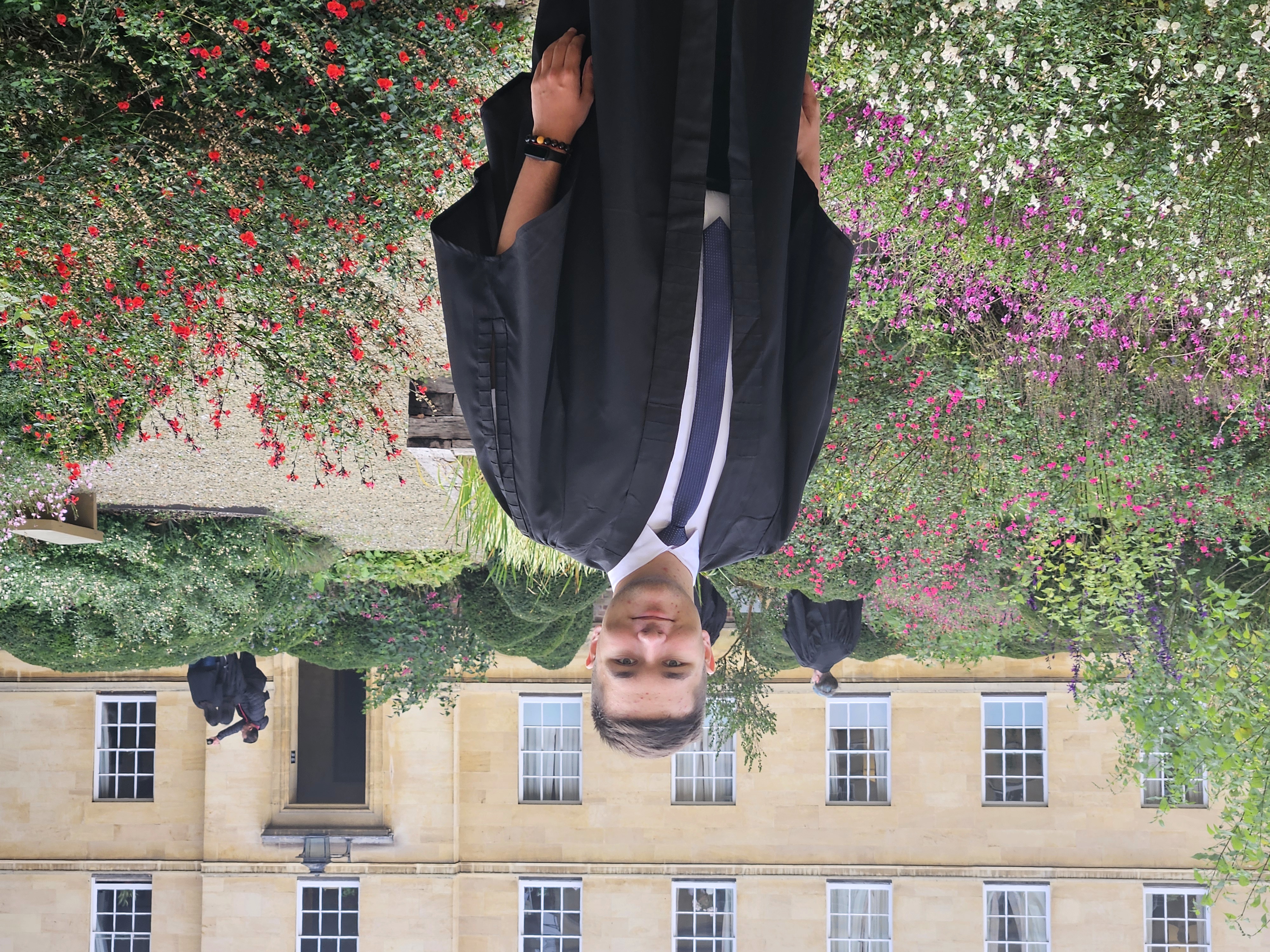
Emilijus is from Klaipėda, Lithuania, and wrote this at the end of his first year studying Chemical Engineering and Biotechnology here at Christ’s College, Cambridge.
At school, Emilijus did the International Baccalaureate Diploma with Mathematics AA, Chemistry, Physics and English B at Higher Level, and Lithuanian A and Psychology at Standard Level.
Picture (right): Emilijus wearing his gown in Third Court.
What attracted you to Chemical Engineering?
At school, for many years I could not answer the question most of us have been asked multiple times: “What are you going to study after finishing school?” For me, the biggest roadblock to choosing a subject was that I enjoyed learning all the natural sciences at school (and for science olympiads), especially physics, chemistry, and biology.
The Chemical Engineering and Biotechnology Tripos (often shortened to CEBT) offered just the balance I was looking for. In the first year alone, we’ve covered multiple topics related to these sciences. The year consists of two different sections: the Chemistry and Mathematics subjects taken from the Natural Sciences Tripos, and the five modules specific to CEBT. Of these five modules, Cell Biology taught us the principles we need to enter the sphere of biotechnology, Process Calculations made us think like real chemical engineers, Engineering Principles allowed us to use physics to determine how physical structures, dynamic systems and electrical components work, Material Science showed us both how to process and choose the correct materials, and what molecular interactions create the desired properties. Finally, Fluid Mechanics enabled us to analyse fluids in different flow regimes and understand how pumps and mixers work.
In my opinion, the best part of all of this is that the modules we studied integrated with each other very well. For me, Chemical Engineering and Biotechnology served as the perfect balance between the different scientific disciplines, as well as the theoretical and the practical sides of science.
How did you find out about Chemical Engineering?
I found out about Chemical Engineering and Biotechnology while browsing the Courses tab on the Undergraduate Study website. The most useful resource for me was the description of the content of the course, which is given in the “Course Outlines” section on the Cambridge Undergraduate Study website. Having a concrete idea of what I was going to study helped me feel much more confident about applying to study this course.
Did future career ambitions play a part in your course choice?
In the future, I aspire to apply the knowledge I learned at Cambridge to have a direct positive impact on our society. My future career ambitions definitely played a part in my course choice, as I was looking for a degree that had a good balance between the theory and the application. Of course, this balance is different for everyone. But for me, not only knowing how to derive and study chemical and biological processes but also having the ability to apply them and scale them up matters the most. That is why I chose this course - it provides you with a great toolset to use in your career.
Why study at Cambridge, in the UK?
The main thing that encouraged me to apply to Cambridge was the study environment here. An important factor was that the quality of teaching here is among the highest in the world. I loved the concept of supervisions – small group teaching sessions with an academic and up to three other students. They allow us to plug any gaps in our knowledge and ask any questions that come up about our course and the subject. I find this freedom to be curious and to dig deeper very valuable. Since I was sure about the course and the quality of studies, this left me feeling no doubt when pressing the “Apply” button.
Even though I applied and got accepted to multiple other highly regarded universities in the UK and the US, Cambridge was always my first choice. Everything about it came together very nicely. CEBT was exactly the course I was searching for, and it was a perfect match for my future goals. Also, the social and cultural environment here seemed like the best fit for me – I could connect with the people here. And it was also practical - Cambridge is quite conveniently located, as it takes me only a few hours to get here from my home in Lithuania. The thing that set my choice in stone was my visit to Christ’s during an open day. I loved the college, especially the atmosphere inside it and the people studying and working here. After that trip, I knew that this was the place I wanted to spend the next four years of my life.
Was there anything that you were nervous about when you arrived?
When my studies started, I was quite worried about keeping up with the lectures. Compared to school, there is significantly more content covered in fewer lectures, while the concepts are considerably more complex. However, I got used to the pacing after a few weeks. The difficulty jump can be hard to manage at first, but it feels significantly better a few lectures in. The courses at Cambridge are designed to feel challenging, as that pushes you out of your comfort zone and helps you improve.
What is the College system and why Christ's?
I found out about Cambridge Colleges soon after beginning my research on what to study at university. Although this system seemed quite strange at first, after a bit of reading, it started to look relatively straightforward. In summary, the University is responsible for the academic side of things (most notably, the lectures and the course itself), while the College is where you live, socialize, and have most of your supervisions.
Just like with my course choice, Christ’s had the perfect balance of the factors that matter to me. First, I really liked the aesthetics of the college: the Fellows’ and Third Court gardens, the buildings and each court acting as its own separate space make this college feel very cozy. Christ’s is relatively small compared to the bigger colleges, but there was more than enough space for everything I needed throughout the year. Second, the location is very convenient, as the college is in the centre of Cambridge. But this doesn’t come at the cost of peace, as the college remains mostly quiet even when some other colleges deal with an onslaught of tourists. Another reason I chose this college was due to the very high reputation for academic excellence. Since everything came together nicely, I was confident in applying to Christ’s.
My first year at Christ’s has been great: I love being at the college and the community is amazing.
What matters the most when choosing a college is that when reading about it and looking at the photos, you can imagine yourself being in that space. It might be difficult, especially without having visited Cambridge, but following your gut often yields a good choice. Just remember, there aren’t any objectively ‘bad’ or ‘good’ colleges, just the ones where you will thrive the most. Personally, I found Christ’s to be the best college for me, and I’ve been very happy with my choice ever since.
How did you approach the ESAT?
When I applied to study Chemical Engineering and Biotechnology, it was the first year that the ESAT was conducted. The exam is quite intense, as you have less than 1.5 minutes per task on average. My best advice for preparation would be to solve as many past ESAT papers as possible, and to get familiar with the pacing of the questions. For some computationally intensive questions, it is quicker to figure out how the answer should approximately look and select the correct answer by process of elimination rather than deriving the full expression yourself. This is more error-prone, but sometimes necessary given the time pressure. But most importantly, don’t stress out about the ESAT too much. It is only one of the multiple factors that determines admission. Yes, it is important, but if it doesn’t go the way you would’ve liked, that won’t upend your application.
What were the most challenging parts of the application process?
I would say there are two types of ‘challenging’ in the application process. The time-consuming aspects of the application (such as writing a great personal statement or doing all the paperwork) do require a lot of patience, and that is a challenge by itself. However, for me, the most challenging parts were those where I was under strict time pressure, namely the ESAT and the interviews.
What makes a strong application?
In my opinion, good knowledge of mathematics is very useful, and chemistry is a close second. But what matters the most when applying to study here is that you don’t study just by learning to recall the concepts – you should take care to fully understand and comprehend them. During your studies and the Tripos exams, you will likely deal with problems and concepts you haven’t seen before but should be able to understand if you have a strong base of knowledge. This is one of the abilities that are being tested in the interview stage of the application.
Alongside the raw ability to learn and comprehend, there should always be passion for the subject. People reviewing applications can tell quite easily whether or not the student is genuinely interested in what they are going to study. So, don’t be afraid to go the extra mile: channel your enthusiasm to read up on some new concepts and reinforce what you have already learned. This will definitely make a difference.
What matters the most when applying to study here is that you don’t study just by learning to recall the concepts – you should take care to fully understand and comprehend them.
What were the online interviews like?
I had two interviews, with one focusing on chemistry and the other on mathematics. There were two different interviewers for each one. It all took place in a Teams meeting, where a digital whiteboard was used to write notes and solutions to the questions they would give. The interviews were quite intense, as there were many questions to get through in such a short time. One thing I found quite unexpected was that sometimes, the interviewers move on to the next question while the one before is not yet fully solved. This happens mostly for time-saving purposes – if the rest of the path towards the solution is very clear, the time is better used to move on to more complex questions. The best way to approach an online interview is to be open-minded. Think out loud, don’t be rigid in your solutions, and get ready for unexpected questions.
How did you prepare for your interviews?
I mainly prepared by reading my notes on chemistry and mathematics. I also researched my interviewers. Having read about them helped me feel calmer and more comfortable before the interview. There’s not much else you can do to prepare - there is no syllabus or ‘past papers’ for Cambridge interviews. What matters the most is that you are ready to solve unseen problems by applying the knowledge you learned at school, critical thinking, and a touch of creativity.
Note from the admissions office - it's fine to research your interviewers as Emilijus did if it helps, just one piece of advice as people sometimes get this wrong: don't get too hung up on what the interviewers' research interests are. They are not looking for people with the same interests.
What advice would you give to applicants?
Be patient with the process (as it takes a while) and try to do each step of the application to the best of your abilities. The work you put in during this period will pay off for years to come. And don’t forget to read your emails! The admissions officers write them for a reason. Lastly, if the application goes differently from the way you imagined, don’t beat yourself up over it. Sometimes the best path for you is not the one you intended to take.
Before coming to Cambridge, what did you look forward to / worry about?
Before coming here, I was really looking forward to joining the community at Cambridge and Christ’s, and meeting lots of wonderful people. I was also excited to begin a new chapter of my life and experience studying at my dream university.
The thing I was most worried about was the practical side of this change. I was seventeen, going to live by myself in a different country. But after all the administrative work (getting a bank account, registering with the NHS, etc.) was complete and I settled in, everything happened without much difficulty. Turns out, big changes aren’t that scary when you focus on one thing at a time!
Turns out, big changes aren’t that scary when you focus on one thing at a time!
Any advice for students applying from Lithuania in particular?
If you feel that Cambridge is the right place for you and that you can thrive in this environment, then you should definitely apply! This is an amazing opportunity to learn from some of the leading academics in their respective fields, experience living in a historic university city, and become part of the welcoming community at Christ’s, where you can meet some of the kindest and most interesting people in the world.
Doing everything in English was a bit strange at first, but I quickly got used to it. One thing that helped was that I took the International Baccalaureate Diploma Programme, which meant that all my study materials and exams were in English. This helped soften the transition to using English for everything in my daily life. I also had to meet an English language requirement for my offer. In my case, this meant that I needed to achieve a 7 (the highest grade) in Higher Level English B in my exams.
Tuition fees for international students can be quite high, so scholarships are a huge help. I made the finances work by applying for the Kitas100 scholarship, funded by the State Studies Foundation of Lithuania (Valstybinis studijų fondas). It is a scholarship that specifically focuses on supporting students at the world’s best universities.
A small practical difference I’ve noticed is that the food sold in British supermarkets is slightly different from what you would find in a Lithuanian one, so this might come as a small surprise! But generally, there aren’t too many cultural differences between Lithuania and the UK that would create any major inconveniences. Just remember to cycle on the left side of the road, and you should be alright!
Are there other students from Lithuania who you see in Cambridge?

There are quite a few of us Lithuanians studying at Cambridge!
We have an active university-wide society (CULS – Cambridge University Lithuanian Society) with various events, such as formals, visits from Lithuanian professors or political figures, and more.
I meet up with other Lithuanians quite often – whether through the society or otherwise – and it’s great to have the chance to spend time with people while being able to speak my native language.
It’s also nice that I’m not the only Lithuanian at Christ’s in my year, so we bump into each other quite often in college, even though we study different subjects.
Picture: Emilijus with Justas (on the right), a fellow Lithuanian student in the same year.
This is an amazing opportunity to learn from some of the leading academics in their respective fields, experience living in a historic university city, and become part of the welcoming community at Christ’s, where you can meet some of the kindest and most interesting people in the world.
Did you find it easy to settle in?
Settling in was easier than I expected! What really helped was that there were a lot of us freshers, and that we were all dealing with the same questions. This shared experience helped all of us navigate the first weeks better by making friends and building a strong support network.
Can you tell us about freshers' week?
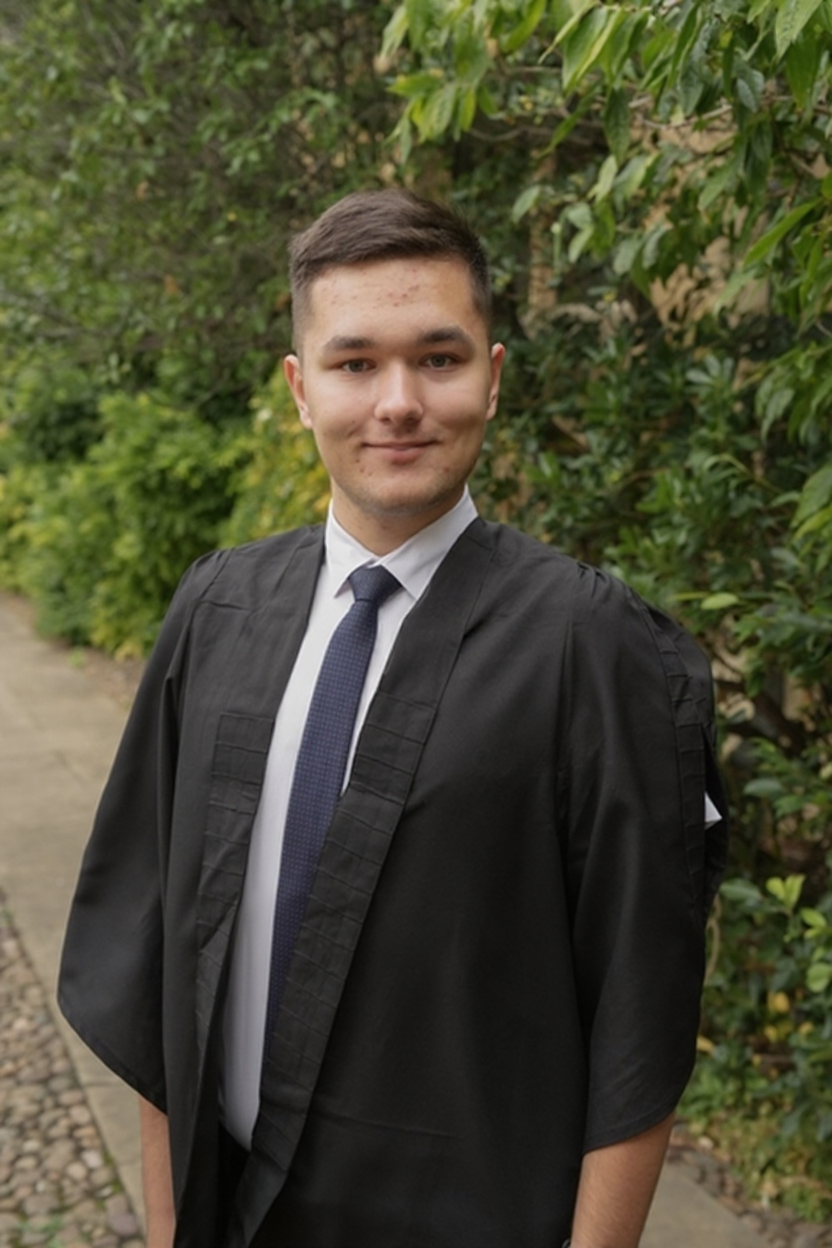
My Freshers’ week was full of emotions and new experiences. One of my favourite memories comes from the International Freshers’ week, when we went to an escape room. There I met one of my coursemates for the first time and had a blast solving riddles with freshers from Christ’s I had only just met. Who would’ve thought that Cambridge students would be so good at escape rooms? Overall, every activity we did during the week was fun, social, and definitely worth the time. Try to make the most of your Freshers’ week – it’s an amazing opportunity to make friends and have a great time!
I was pleasantly surprised by the community here. I expected to find myself in a very introverted and study-focused environment, but I met many fun, sociable, and down-to-earth people who manage to balance both the social and the academic aspects of university life very well.
Picture: Matriculation Photo - Matriculation is when you officially become a member of Christ's College and the University of Cambridge.
How did you find starting lectures and supervisions?
University lectures and supervisions are quite different from anything I had experienced at school. That’s why I had to change my style of studying and note-taking. The lectures here are quite intense - you seldom have enough time to note everything down. These 50 minutes are packed with content, so you should focus on listening carefully and not writing down everything the lecturer says. During my first year, I had different strategies for note-taking for each subject. For example, in Fluid Mechanics or Mathematics, I could write everything I might need for exams in my notebook, while in Cell Biology lectures, it was best to just keep a mental note of the most important concepts and revisit the lecturer’s slides during revision.
Supervisions were quite similar across subjects. Most of them followed the same workflow. First, you do practice problems from the lecture content before the supervision and submit them to the supervisor. Then, in the supervision, you receive marked solutions and have an opportunity to analyse any mistakes you made or questions you had about the problems or the lecture content. My favourite moments in supervisions were when we would go off the main topic and discuss some interesting phenomena we hadn’t learned about yet. Discovering things in science I didn’t know or understand before under the guidance of the supervisor was always a very fun and rewarding experience.
How is the work different to what you experienced at school?
One change I’ve noticed is the shift towards studying individually, and not during lessons or lectures. At school, I would learn most of the content in the lessons and consolidate it while doing homework. Here, lectures are mostly for familiarizing yourself with the content and developing an understanding of the concepts relevant to the course. I had to put in quite a bit of individual work to fully understand some of the more complex topics this year, and solving problems for the supervisions helped with that.
What are the best and the hardest parts of your course?
In my opinion, the best part about my course is the projects. I loved doing product design, engineering design and manufacturing, and bioinformatics. These group projects were not only interesting and enjoyable, but they also allowed us to directly apply the knowledge we learned in lectures in real-world situations and research. For example, designing a biochemical product and pitching it to a panel of real investors taught us a lot of soft skills about planning, teamwork, and presentation that go hand-in-hand with our academic knowledge. I believe that this part of the CEBT course plays an important role in preparing us to join teams of researchers and entrepreneurs in our future careers.
During my first year, the most difficult part of my course was managing large amounts of interdisciplinary information effectively. Memorizing the knowledge is far from being the same as actually knowing it – full comprehension requires time, and there was not a lot of it. Even though there is no single part of the course that is too difficult for us to learn, the biggest challenge comes from learning all of them and holding all of this new information in your mind at the same time when the Tripos exams come.
Is the course what you expected when you applied?
I would say it is even better than what I anticipated! I expected to learn a lot of interdisciplinary information relating to chemical engineering and biotechnology, but I got much more than that. The theoretical base, together with the practical components, allowed me not only to analyse real-world problems, but also gave me the tools to build the solutions.
What do you feel that you've got out of first year?
My goal during this year was to gain a strong footing and have a great start that would set me up for success in the years to come. And I believe I did just that! Academically, I’ve found what works for me. I now know how I will study different modules in my Tripos, balance my workload and prepare for next year’s Tripos exams. While some strategies this year worked better than others, that was the beauty of it – being outside of my comfort zone allowed me to pursue a higher level of knowledge and understanding. And looking back, I’m happy with the overall result.
Getting a First was not my only focus, though – academics is only one part of the experience at Cambridge. I also got a lot out of the social interactions I had with my friends here. New ideas, shared experiences, awesome memories, and fun conversations we had made this year even more enjoyable and full of discovery. The terms were quite short and intense, but we’d make the most out of the time we had, and that made each experience even more special.
Generally, I learned a lot of different small things that come with living, studying and socializing here. And now, as the year has finished, I already feel like a different person: smarter, more sociable, and ready to tackle whatever challenges I will face in the future. A good beginning is half the battle!
Now, as the year has finished, I already feel like a different person: smarter, more sociable, and ready to tackle whatever challenges I will face in the future. A good beginning is half the battle!
How does your teaching work?
The number of lectures varied, but the following gives a good idea of the workload:
Usually there are ten 50-minute lectures a week, with three each for NST Mathematics and NST Chemistry, and four for CEBT-specific modules.
For an NST module (Mathematics, Chemistry), we’d have one supervision a week, and for a CEBT module, we would usually have one supervision every two weeks.
On top of that, we would have additional contact hours for the CEBT projects and NST practical work.
My best advice with regards to teaching would be to try not to miss any contact hours, as they are the most efficient way to learn. I followed this advice myself this year – I didn’t miss a lecture, and that made keeping up with the workload much easier.
How do you manage your workload?
The workload during the term is quite intense, but still manageable, provided you don’t procrastinate too much. For me, what worked was setting at least one task to complete after lectures for each day. For example, I would complete and submit my chemistry supervision problems on Monday, do the same for mathematics on Tuesday, finish the next stage of work on a project on Wednesday, and so on. Setting short-term deadlines helped to keep everything in check without it feeling overwhelming. Following this allowed me to free up some afternoons and evenings to take care of my social life, among other things. Having an organized system helped me avoid burnout and maintain a good work-life balance.
One thing I would approach differently next year is preparation for the Tripos exams. This year, I mostly left the bulk of my revision to Easter Term. This worked well, as there was enough time to go through all the content, but it got quite intense towards the end. To make this easier next year, I’ll try to be exam-ready on each completed module by the end of the corresponding vacation, making Easter revision easier and less stressful.
Where do you typically like to work?
While many students prefer to work in their departments, the University Library or somewhere in college, I found that studying in my room works best for me. While going out to work or study with your friends somewhere else is nice for a change, I didn’t find it very practical in terms of productivity. Of course, everyone has different preferences, so make sure to try out multiple spaces and see what works best for you!
What was your favourite topic this year?
I loved creating a model predicting climate change as coursework for the Sustainability module. It was very interesting to model such a complex phenomenon while considering the physics and the variables that determine what our world will look like in the future. I enjoyed playing around with the model and observing how it responded, especially when small changes in the assumptions could compound into large differences down the line. This project is an example of what I love about my Tripos - we don’t stop with the theory - we get to actively apply it, tinker around and fully understand how these phenomena work, boosting comprehension and making the studies much more enjoyable.
We don’t stop with the theory - we get to actively apply it, tinker around and fully understand how these phenomena work, boosting comprehension and making the studies much more enjoyable.
What are your favourite and least favourite things about Christ’s?
My favourite thing about Christ’s is the community. Since the college is not too large, you know most of the people that you see, which definitely makes it feel very close-knit. The people here have been some of the friendliest and most interesting people I have met, and I am very happy to be a part of this community.
My least favourite thing about Christ’s is that some residential buildings get really hot during a heatwave. It’s a very minor thing (and it’s quite manageable), but it is quite difficult to think of anything else I don’t like about Christ’s!
What have you enjoyed most about life at Christ’s this year?
I really like the way that college life blends into my general routine. Right now, Christ’s is my second home – a place where I can relax after a busy day, socialise with friends and have a little bit of fun. This feeling of familiarity and belonging during my day-to-day life has been one of the most enjoyable parts of being at Christ’s.
What do you do when you're not working?
When I’m not working (which doesn’t happen too often during term), I either do something with friends or just relax by going for a walk around central Cambridge. I have also joined Christ’s Voices – the college’s non-auditioned choir - and often go to the Board Games Society to have some fun. These activities provide a much-needed contrast to the rigorous academic environment I spend most of my time in.
Where have you lived this year?
This year, I lived in college, as is compulsory for all freshers at Christ’s. I was in the Y Building (Third Court). I liked it because it was very convenient, as most of my daily non-academic life revolves around the college. This meant most of the things I needed to get to, whether they were supervisions, some activities or Upper Hall (our college’s dining hall), were just a minute or two away. Living in college also meant that I would bump into people I know more often, which was always a welcome surprise. Additionally, my room had a great view of the Third Court garden, which was a big plus!
How do you spend the vacations?
This year, I spent all my vacations back in Lithuania. There were always quite a few things to catch up on, especially after being away for more than two months! After I had caught up with friends and family, I would usually have some rest and spend some time on my hobbies. Term time is intense, so having some time to slow down helped me recover and recharge for the next term. Of course, during the short vacations, once I was all caught up and rested, I would revise what I had learned throughout the term, as this is the best opportunity to do so
What are you most looking forward to next year?
I can’t wait to see what I will study next in my Tripos and what new projects await me. I haven't had the time to look into the modules I'll take yet - I've only seen a few of the modules I'm going to have, and I'm very excited to start learning them!
I also really look forward to seeing all my friends again and joining them in different societies or other activities. Life at Cambridge is intense, but my time here has been among the best experiences of my life.