
Christ's is excited to be offering the Linguistics and Modern Languages course (new for 2027 entry), combining our teaching strengths in both languages and linguistics.
 Linguistics and Modern Languages integrates the scientific study of language with the study of languages, culture and history of most European, and many non-European, countries.
There's a lot of information about this course below, including details of how to apply and super-curricular resources.
The Linguistics and Modern Languages degree lasts four years. You'll study in Cambridge for the first two years, the third year is spent abroad, immersing yourself in the languages and cultures that interest you the most, then you return for a final year in Cambridge.
Students study one modern language in depth out of French, German, Italian, Portuguese, Russian or Spanish. If you want to study French, you must have taken it at A level, IB Higher Level, Scottish Advanced Higher or equivalent. In all other cases, you can study the language from scratch. If you have already studied your chosen language at A level or equivalent, you will study at a more advanced level.
Alongside your language work, you will also explore Linguistics, looking at how the scientific study of language can help us understand the human mind and creativity. Areas of Linguistics study will range from language in general to individual languages and language families. You’ll apply mathematical and digital techniques to explore language acquisition, pathology and evolution. You may:
> study rhythm in speech and how this is used by poets
> learn how we can record brain responses to language
> explore creativity in young children as they acquire the grammar of their language
> evaluate the outputs of large language models (AI systems) on translation tasks
The range of topics available to study across linguistics and modern languages means you can develop your own curiosity about how these areas intersect.
Please visit the University website for full details of the Linguistics and Modern Languages course content and structure. You will also find information on the Languages Faculty website. If you have further questions about course content, please contact facultyoffice@mmll.cam.ac.uk.
You can generally expect around 12 to 14 hours of teaching each week.
You'll go to the university-organised lectures and classes on the Sidgwick Site, a 15 min walk from Christ's. In language classes, you’ll get individual feedback from your teachers, outlining how you can improve further. For some of your linguistics classes, there will be practicals where a more hands-on approach is followed, for example using speech analysis software for visualising and quantifying speech acoustics.
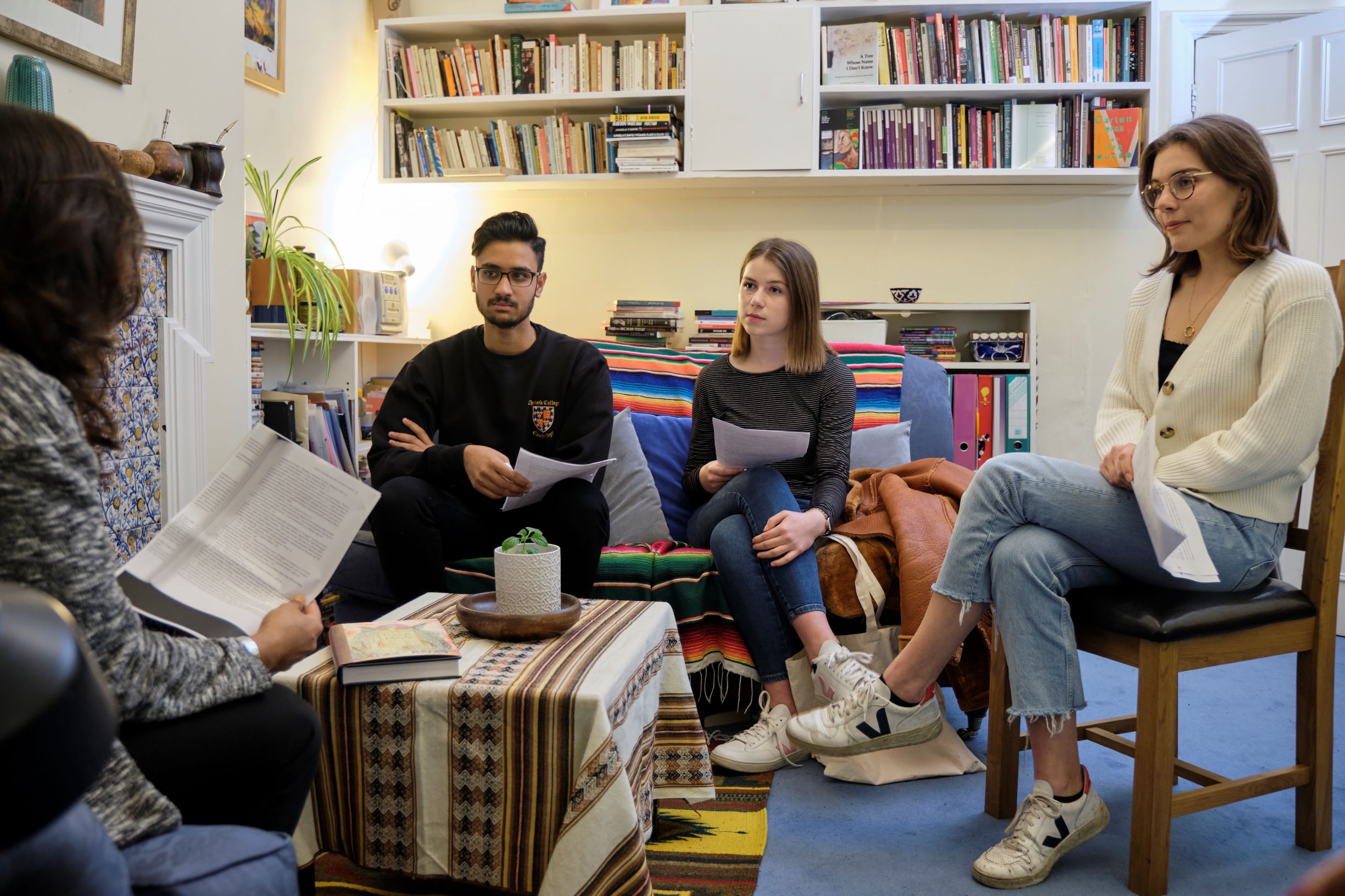
As well as lectures and language classes organised by the University, Christ's gives you 'supervisions' each week. These small-group tutorial sessions (1-to-1 or in pairs) give you personally-tailored tuition and support – one of the advantages of a Cambridge education. You prepare written work which you then discuss with a specialist in the field. The Christ’s Directors of Studies arranges the supervisions for you and can offer guidance whenever you need it. There's a film on supervisions here.
Teaching staff at Christ's include:
Mary Franklin-Brown (French)
Ksenia Zanon (Russian and Linguistics)
Stephanie Rohner (Spanish and Portuguese)
Emily Tomlinson (French)
Carlos Iglesias-Crespo (Spanish)
Anita Bunyan (German)
Giulia Boitani (Italian)
Felipe Schuery (Portuguese)
In the Linguistics and Modern Languages degree you will develop skills across arts and humanities, technology, and science, as well as a deep understanding of the multifaceted and central status of language in literature and culture, human cognition and communication, language education and policy, health and well-being, and information technology. This will prepare you well for careers in language learning, teaching, assessment and training, including options to teach in multicultural and multilingual parts of UK, for data-mining in social media in other languages, or involvement with communications teams, health professionals and looking after neurodiverse individuals.
How to apply
Visit How to Apply for full details and a timeline of the application process. We welcome applicants from all backgrounds and school types, all over the world. If you're applying from outside the UK, please read our international students section.
See the drop-down information below for details about applying for Linguistics and Modern Languages at Christ's. Note that there are no admissions assessments at this College.
If you apply for French it is a requirement to take French at A level, IB Higher Level, Scottish Advanced Higher or equivalent.
If you apply for German, Italian, Portuguese, Russian or Spanish, there is no requirement to be studying the relevant language already, as these languages can be studied from scratch, however if you have already studied your chosen language at A level or equivalent, you will study at a more advanced level on the course.
For your other subjects, we have no requirements, but when choosing your post-16 options, we recommend Languages, English (literature or language), History, and/or Mathematics as subjects that would be helpful preparation for Linguistics and Modern Languages.
We encourage students to attend one of our regular Subject Matters webinars for help with choosing Post-16 subjects for competitive university applications. This webinar is pitched for students aged 14-16 though it is also possible to attend when you have started sixth form.
After you have applied, Linguistics and Modern Languages applicants are asked to upload ONE piece of marked written work.
If you are applying for a post-A level or equivalent language please provide a piece of work written in the European Language that you plan to study at Cambridge. It should preferably be an essay on linguistics, literary texts, history or philosophy. If you don't have anything on linguistics, literary texts, history or philosophy, any piece of work in the European language you intend to study is acceptable.
If you are applying for a language that you'll study from scratch, please provide a piece of work written in English that you feel accurately reflects your abilities and interests.
In both cases we are looking for a piece of written work that has been completed during the normal course of your school studies and marked by your usual teacher. Full written work guidelines are provided as part of the current applicants section on this website (published on 20 September each year), and the deadline for uploading your work will be in early November.
If we select you for interviews, these take place online (on Microsoft Teams) in early December. Selected candidates have one Linguistics interview and one Modern Language interview. You will normally have two interviewers in each interview, and you can choose to do your interviews at home (most candidates do this) or at school if easier.
There is no written assessment for Linguistics and Modern Languages here at Christ's, but you will be given some comparable problems to the Linguistics assessment to prepare before your Linguistics interview starts, and you'll then work through the problems with the interviewer in the second half of the interview that follows (it will be an extended interview). Details will be given in your invitation to interview.
Shortly before your Modern Language interview, you will be sent a short text to read, for discussion during the following interview. An interview for a language you have already studied will include a text in that language (and perhaps some questions to think about as you read it); interviewers for a language you wish to learn from scratch will instead set a text in English, but will be seeking to gauge the level of your commitment to your chosen language, as well as general linguistic and analytical aptitude.
Our aim is to explore your aptitude and potential for the Linguistics and Modern Languages course at Cambridge, rather than to assess what you already know. During the interviews we might ask you about topics you’re not familiar with. Our aim is to assess your innate ability when working through unprepared questions. It’s not about catching you out.
There is no additional 'general interview' - you just need to attend the two interviews scheduled for you and do the preparatory reading before your Modern Languages interview.
Further, more general information about interviews (including two useful films) is available in the Cambridge interviews section, and it's worth also having a look at supervisions (short film here), as interviews are similar to what you do every week as a Cambridge student.
We define the terms of each offer individually, but the minimum conditional offer for Linguistics and Modern Languages is:
> A*AA at A-level
> 42 points overall in the International Baccalaureate with 7,7,6 in relevant Higher Level subjects
> A1, A2, A2 in three Scottish Advanced Highers
You need to be academically ambitious: the majority of Christ's students arrive with higher grades than are required.
If you’re taking another qualification, we expect you to be working at or close to the top of the mark range i.e.
> Baccalauréat français international (BFI): 17 (mention très bien) out of 20 overall, with a minimum of 17 in individual subjects.
> European Baccalaureate: at least 85% overall, with 9/10 in relevant subjects
You can look up other qualifications in the offer levels for other exam systems and international entry requirements, and if you are applying from outside the UK please read the Christ's international students section for further information and check the country pages.
If you will have finished school when you apply, please also read about post-qualification applications, taking a gap year, and, if relevant, applying from a university.
If you're learning a language, do make use of Online Newspapers and ListenLive (radio). Parallel texts can also be very helpful. There's a Penguin Parallel Texts series, available in German, French, Spanish, Russian, and Italian. A collection of short stories by various authors, with English translations. See the Waterstones website (between £8.99-£15.99), and check AbeBooks for cheaper second-hand copies. See also the Cambridge Collaborative A level Resources - playlist, Intro in French and Intro in German.
For students who are looking for an introduction to Linguistics, the Christ's Director of Studies particularly recommends Chapter 1 of Essentials of Linguistics (a FREE online textbook - just click on the link). We do need to emphasise that this is only a suggestion - it's not required reading for applicants to Christ's or anything like that (there's no disadvantage if you've been reading other things). Note also that we do not recommend that you read the rest of the textbook, just Chapter 1. If you are looking for further introductory reading for Linguistics, see these reading suggestions.
Although there is no assessment for Linguistics and Modern Languages at Christ's, looking at the Linguistics assessment information and past papers will help you to prepare for online interviews.
Podcast suggestions: Because Language (all areas of linguistics); Lingthusiasm (all areas of linguistics); The Vocal Fries (specifically sociolinguistics); En Claire (specifically forensic linguistics); Spectacular Vernacular (all areas of linguistics).
National Linguistics Olymipads are competitions where you solve linguistics problems. See for example UK Olympiad (and their useful set of past problems). Other countries often have similar resources pages e.g. Australia, Ireland, USA to give a few examples from anglophone countries. Enjoy these but please don't worry if they seem difficult - they are designed to be challenging and are in general more involved than problems and puzzles that you would normally encounter in Cambridge interviews.
Open Days and online events
Our open days and events page advertises regular online opportunities as well as events you can attend in Cambridge. Between February and August we run regular webinars:
> Subject Matters: The importance of post-16 subject choices
> Cambridge for Beginners
> Personal Statements and preparing for an application
> Webinars for applicants outside the UK
For MML, see in particular
> College Open Days
> World of Words residential in March/April (eligibility criteria apply)
> Language Faculty Open Day in March (feel free to Visit Christ's the same day)
> Christ's Online Subject Meetings in May
> Christ's MML/LML 1:1 zoom meetings in June/early July.
If you are able to come to a College Open Day, we will be glad to tell you more about the College and the Linguistics and Modern Languages course in person. If you are not able to come to an Open Day, we will be happy to answer any queries you may have by e-mail (admissions@christs.cam.ac.uk).