
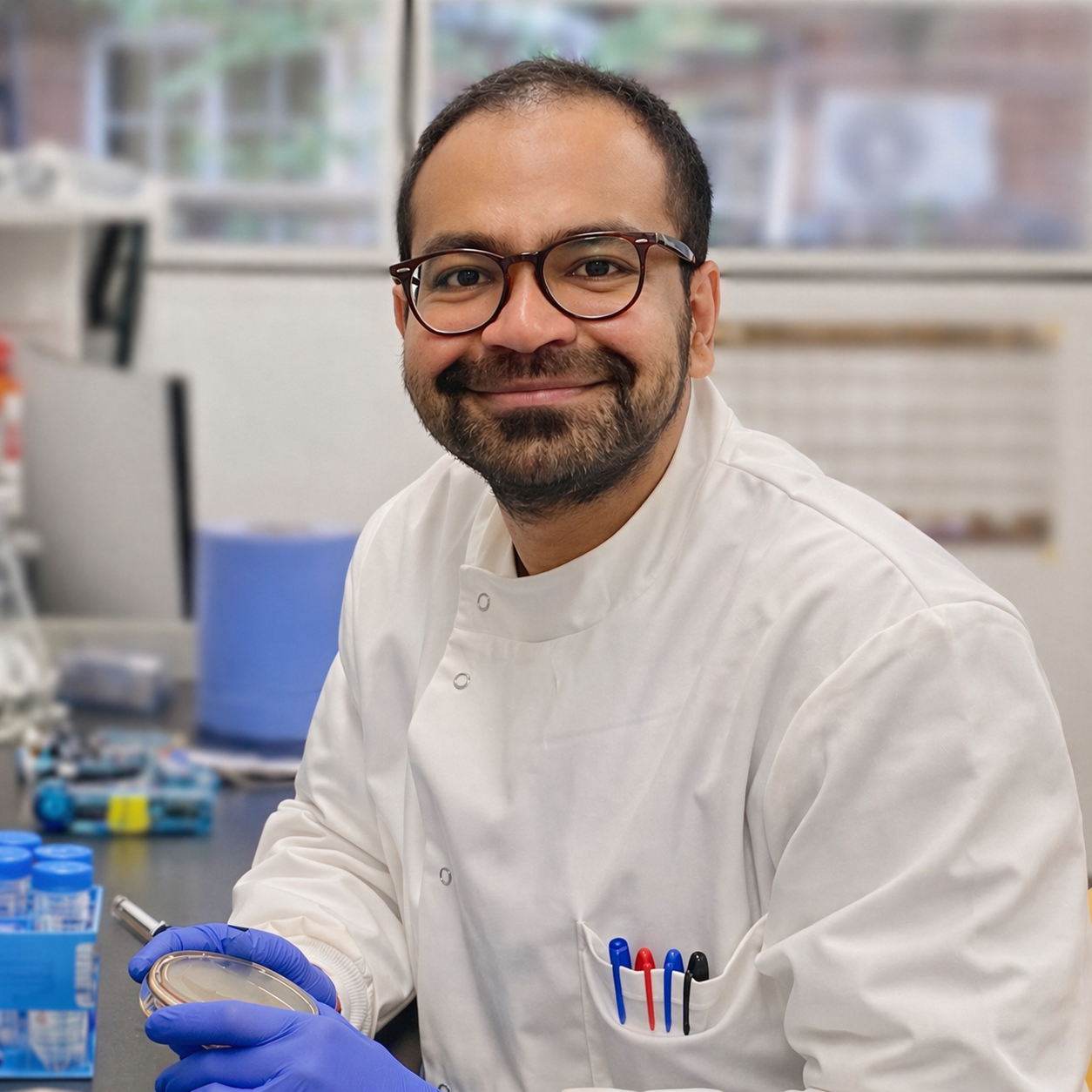
Dr Aakash G. Mukhopadhyay is a Senior Research Fellow in Animal Protozoology, and a Group Leader in the Department of Pathology. His research investigates the molecular machinery that drives ciliary and flagellar function in parasitic protozoa, a group of pathogens responsible for hundreds of thousands of deaths annually worldwide. Cilia and flagella are hair-like cellular structures that enable cells to move, sense their environment, and communicate. Combining structural biology, biochemistry, and advanced imaging approaches, his work seeks to understand how these conserved cellular systems are adapted in pathogens.
Aakash completed his PhD at the Indian Institute of Technology Delhi, where he studied the mechanisms regulating flagellar motility in the parasite Leishmania. During this time, he developed in vitro approaches to investigate the signalling pathways and chemical messengers that control parasite swimming behaviour. Motivated by the striking parallels between flagellar systems in parasites and the ciliary pathways essential for human development and disease, he expanded his research into mammalian systems. During his postdoctoral work at Birkbeck, University of London, and subsequently at the Sir William Dunn School of Pathology, University of Oxford, he developed genome-editing and live-cell imaging approaches to study intraflagellar transport systems and motor proteins that regulate ciliary assembly and signalling. Together with biochemical and structural biology approaches, his work has contributed to understanding how cilia and flagella transport signalling receptors and how specialised motors function within these pathways.
Beyond research, Aakash is committed to mentoring, representation, and building inclusive scientific communities. He has trained researchers across multiple career stages, contributes to outreach initiatives that promote access and diversity in STEM, and supports environmentally sustainable research practices. He is also actively involved in academic service through peer review, editorial activities, and community-building initiatives for early-career researchers.
Selected Publications:
Mukhopadhyay AG, Toropova K, Daly L, Wells JN, Vuolo L, Mladenov M, Seda M, Jenkins D, Stephens DJ, Roberts, AJ. Structure and tethering mechanism of dynein-2 intermediate chains in intraflagellar transport. The EMBO Journal. (2024) 43(7):1257-1272.
Hesketh SJ*, Mukhopadhyay AG*, Nakamura D, Toropova K, Roberts AJ. IFT-A Structure Reveals Carriages for Membrane Protein Transport into Cilia. Cell. (2022) 185(26), 4971-4985. [Joint first authors]
Mukhopadhyay AG, Dey CS. Effect of inhibition of axonemal dynein ATPases on the regulation of flagellar and ciliary waveforms in Leishmania parasites. Molecular and Biochemical Parasitology. (2018) 225:27-37.
Mukhopadhyay AG, Dey CS. Role of calmodulin and calcineurin in regulating flagellar motility and wave polarity in Leishmania. Parasitology Research. (2017) 116:3221-8.
Mukhopadhyay AG, Dey CS. Reactivation of flagellar motility in demembranated Leishmania reveals role of cAMP in flagellar wave reversal to ciliary waveform. Scientific Reports. (2016) 6:1-4.
Awards and Prizes:
Christ’s College Cambridge Research Fellowship (2026)
Award for Excellence, University of Oxford (2025)
Dunn School Transition to Independence Grant, University of Oxford (2024)
Distinction in Doctoral Research Award, Indian Institute of Technology Delhi (2018)