

Who were Finch and Baines?
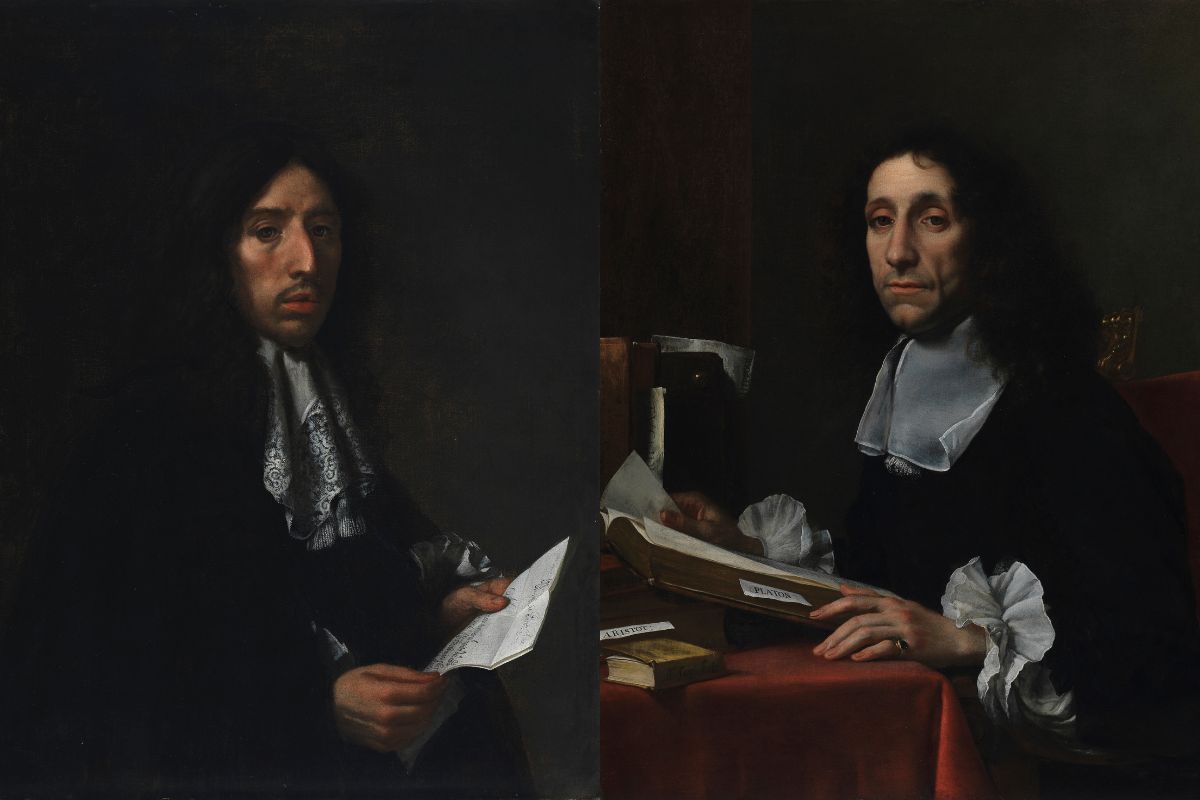
John Finch and Thomas Baines were two extraordinary men, as devoted to intellectual inquiry as they were to each other. Meeting at Christ’s College in the 1640s, they became partners for life, spending the next 36 years together and pursuing distinguished careers in medicine, diplomacy and music in England and abroad. The two men lived through political upheaval, experiencing the English Civil War, as well as the changes during the Interregnum period and the Restoration of the Monarchy.
Finch was born to an illustrious family of political importance; his father was Speaker of the House of Commons, while his brother became the Lord Chancellor of England. Baines came to Christ’s from humbler origins. He shared a set with Finch in the new Fellows’ Buildings as his ‘sizar’: a status which enabled students of modest means to subsidise their living expenses by serving other students.
The Doctors in Italy
In 1651, two years after the execution of King Charles I, Finch and Baines left Christ’s to study medicine and anatomy at the University of Padua, remaining there for over 20 years. Finch became a pioneer in the field of anatomy and was later known as ‘a lynx with a knife’ for his dissections. Baines remained with him, both studying and composing poetry, including on the topic of dissection. In 1659, Finch was appointed Professor of Anatomy at Pisa, and over time, the pair became known as ‘the doctors’ to their friends. In 1660, during one of their brief periods in England, they supported the foundation of the Royal Society, listed together as founder members, and were both made Fellow Extraordinary of the Royal College of Physicians shortly afterwards.
Diplomatic Service
After the Restoration and Charles II’s accession to the throne in 1660, Finch took on diplomatic roles, appointed first as King’s Resident to the Ducal Court in Florence, and subsequently as the Ambassador to the Ottoman Court in Constantinople. Baines accompanied Finch as his constant companion, taking leave of his own responsibilities as Professor of Music at Gresham College. Indeed, following a brief spell apart, Charles II personally intervened to ensure that Baines would always be permitted to accompany Finch on his future diplomatic missions. Both were knighted by the King; Finch in 1661 and Baines in 1671.
A Marriage of Souls
Finch and Baines thought of their relationship as a kind of marriage. In his epitaph to Baines, Finch refers to him as ‘O beloved’, describing how they put away the words ‘Mine and Thine’ as hostile to their friendship, suggesting they held everything in common.
On the Christ’s College epitaph, Henry More uses the words ‘intimate’ and ‘inseparable’ to describe their relationship, and the memorial itself has several features of a traditional marriage monument of the time. It is topped with a single funerary urn to symbolise the mingling of their ashes, and a bow made of cloth which evokes the marriage- or love-knot. Although it would be anachronistic to project back contemporary understandings of same-sex relationships onto Finch and Baines, we know from the writings of those who knew them that theirs was a great love, described by Finch as, ‘a beautiful and unbroken marriage of souls’.
Laid to Rest
It was in Constantinople that tragedy struck the two men when Baines died of ‘malignant feaver’ on 5 September 1681. Finch was devastated, writing in his diary that the loss had ‘cutt off the thread of all my worldly happinesse’. He undertook the necessary work to remove and bury Baines’ viscera in Feriköy Protestant Cemetery and had his bones transported back to Christ’s for burial in the Chapel.
However, Finch, doubtless still deeply grieving for his ‘shared soul’, was unwell himself and succumbed to pleurisy, dying shortly afterwards on 18 November 1682. They are interred together under a single ledger-stone in the Chapel sanctuary. Both men were generous to the college where they had met, leaving gifts of £2,000 each, the combined value of which would be almost £1 million today.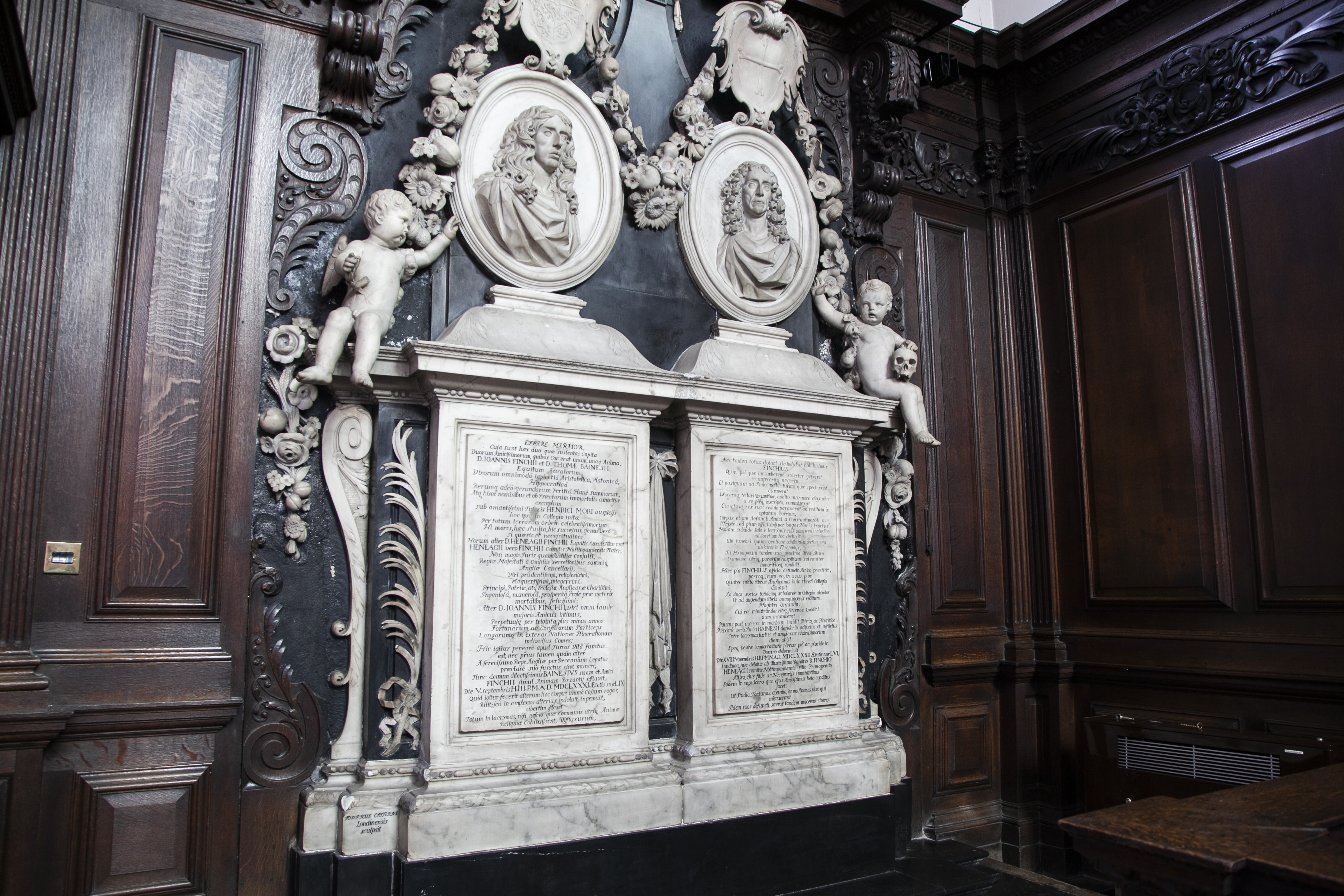
The Memorial
The funerary monument in honour of Finch and Baines was commissioned by Finch’s nephew Daniel, and erected in 1684. It is the only monument executed by the mason Joseph Catterns, and is particularly successful in honouring the relationship between the two men. Two pedestals are crowned with busts of Finch and Baines, joined by a floral bower. Above them we see the single urn representing unity in their earthly lives, and topped with the golden flame of eternal life and love which burns brightly in remembrance of their ‘shared soul’. The accompanying inscription, composed by their tutor at Christ’s, Henry More, has been translated below:
SPEAK, O MARBLE:
whose are these two heads that you hold up?
They belong to two who were most devoted to one another, who shared one heart and one Soul:
SIR JOHN FINCH & SIR THOMAS BAINES,
Knights Bachelor,
men who plainly excelled in every kind of wisdom, whether that be Aristotelian, Platonic,
or Hippocratic,
and equally in the skill of governance,
and for these reasons and for the magnificent example
of their undying friendship,
which began under the auspices of their dearly beloved tutor HENRY MORE
in this very College,
were most famous throughout all the world.
Such were their characters, their pursuits, their successes, but,
if you wish to know their lineage and relations,
one was the son of Sir HENEAGE FINCH, Knight Bachelor,
and in fact the brother of HENEAGE FINCH, Earl of Nottingham,
learned no less in Justice than the Law, His Royal Majesty’s Privy Counsellor and Lord
Chancellor of England,
a most prudent, devout, eloquent, upright man, most dear
to his Prince, his country, and to the Church of England,
in his talented, numerous, and prosperous offspring blessed far beyond
all other people.
The other was the intimate friend of SIR JOHN FINCH, a man in all respects
even more praiseworthy,
for more or less thirty years
his steadfast partner in fortune and counsel
and on long journeys to foreign nations
his inseparable companion.
It was on a trip to Turkey that his life ended,
but not before his friend
had completed his decade-long service as Ambassador of the most serene King of England
with great distinction.
Only then did the dearly beloved BAINES cast out his spirit, and with it the spirit of his friend
FINCH, in Byzantium,
at 3 PM on 5th September 1681, at the age of 59.
You ask, then, what the other body did, now emptied of its soul:
it collapsed; but it grieved, groaned,
wept abundantly
in the other’s embrace and, were it not that some remains of their shared soul
kept it together, would have dissolved completely into tears.
Nevertheless, the most noble
FINCH
did not indulge in his grief so entirely that he was unable skilfully to undertake
and complete the business that was incumbent on him.
And after he had seen to the arrangements
for the embalming of his friend
and committed his innards to Byzantine earth, adding a marble with his own elegant
and pious inscription,
and prepared all of his property diligently for return
to his longed-for homeland,
he also brought the body of his deceased friend right from Constantinople
(a sad but holy duty) across long stretches of sea,
mixing over and over with the salt waves a new saltiness from his tears,
to this Chapel.
Here, when the funeral oration had been given along with mournful but
sweetsounding hymns,
he buried him at last in the chamber located under the adjacent sanctuary,
set up as a shared abode for the both of them, with all due rites
and honours.
These holy duties did FINCH carry out for his deceased friend,
and furthermore donated along with him for pious purposes
four thousand English pounds
to this Christ’s College
for the upkeep of two Fellows and the same number of Scholars in the College,
and to increase by fifty pounds the annual income
of the Master.
While he was intent on managing and duly concluding this matter
in London,
he fell ill after a few months with fever and pleurisy,
being very deeply affected and distressed by longing for his friend BAINES.
Amid the tears, grief, and embraces of his dearest ones,
he passed away
and, full of the hope of blessed immortality, devoutly and peacefully in
the Lord he fell asleep
at 2 PM on 18th November 1682, at the age of 56.
He was brought here from London by the most illustrious Lord DANIEL FINCH,
the first-born son of HENEAGE, Earl of Nottingham,
with other sons and relations in attendance.
Buried here in the same tomb as his most devoted friend
he lies,
so that they who in life had mingled their pursuits, fortunes, counsels
—nay, their souls—
would in death mingle at last their sacred ashes.
This translation is a collaboration between Rene Russell, Development Office, and Dr Bill Freeman, Fellow, Christ’s College.
The Memorial was restored in 2026 thanks to a generous donation from Michael Parsons (m. 1983). You can read more about the restoration here, as well as a longer biographical study of Finch and Baines by Dr Ella Kirsh here.
Further reading:
Crane, P. (2020) ‘The Memorial to John Finch and Thomas Baines in the Chapel of Christ’s College, Cambridge’, Christ’s College Magazine, No. 245, pp. 52-56.
Malloch, A. (1917), Finch and Baines: A Seventeenth Century Friendship. Cambridge University Press.
Mason, J. (2022) Monuments to LGBTQ+ Relationships.
Shepley, E. (2015) A beautiful and unbroken marriage of souls.
Wilson, J. (1995) ‘Two names of friendship, but one Starre: Memorials to Single-Sex Couples in the Early Modern Period’, Church Monuments 10: 70-83.