
History of the Foundation
Statutes were first granted to the College in 1506. By modern standards these were extremely durable, surviving unchanged until 1860. Indeed, the oath which Fellows swore on admission precluded attempts to seek revocation or change to the statutes, though it did not seek to prohibit the grant of additional, supplementary statutes.
University reforms in the second half of the 19th century led to the establishment of University Commissioners, who drafted new statutes for the College in 1860. A further revision occurred in 1882; this version was the first to use English as primary language. Since that time, there has been a fairly continuous process of revision, usually through a stream of minor changes but occasionally by a complete restatement. Change has been for the most part promoted by the College, though a few alterations reflect changes in national education policy promoted by the Government of the day.
A complete redraft of the College's statutes was approved by her Majesty in Council in 1976. The statutes have been revised on a number of occasions since then, the latest occasion being in December 2024.
Statutes and Ordinances - updated December 2025
by John van Wyhe, Bye-Fellow 2005-2010
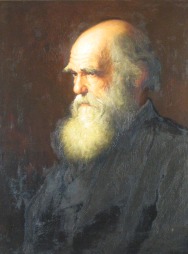
Charles Darwin was an English naturalist whose work revolutionized the life sciences. He is arguably the most famous alumnus of Christ's College.
(Left) The portrait of Darwin which hangs in the College hall is a copy (1883) by the artist, Walter William Ouless (1848-1933), of one commissioned by the Darwin family in 1875 as a birthday present for Darwin. Darwin quipped the portrait made him look like "a very venerable, acute, melancholy old dog".
Darwin's name was entered in the admissions books at Christ's on 15 October 1827.
Admissi sunt in Collegium Christi a Festo Divi Michaelis 1827 ad Festum eiusdem 1828 :
[No. 3.]
Octobris 15. Carolus Darwin admissus est pensionarius minor sub Mro Shaw.
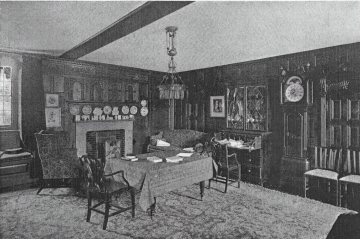
Darwin's room in 1909
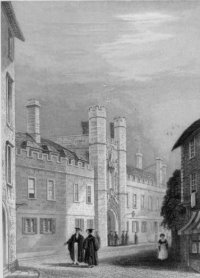
Christ's in the 1830s
However, as Darwin had forgotten much of his school Greek, he was tutored before coming up to Cambridge in the Lent Term of 1828. All the College rooms were full so Darwin took lodgings over the tobacconist's in Sidney-street, the site now occupied by Boot's the chemist. The view from his window would have been that of the engraving (right). A blue plaque under the the first floor windows of Boot's commemorates Darwin's stay there. On All Saint's Day in November 1828 Darwin moved into a set of rooms in College, as he later recalled, "in old court, middle stair-case, on right-hand on going into court, up one flight, right-hand door & capital rooms they were." According to College tradition the same rooms were once occupied by the great natural theologian, William Paley (1743-1885) whose portrait faces Darwin's in the hall and in the stained glass of the hall's south window. (See below) Darwin's father intended him at this time for the church and Darwin was not altogether unhappy with this prospect. It would provide the leisure and freedom required to pursue his growing scientific interests. While at Christ's Darwin became an avid beetle collector. He had a special six-drawer cabinet built to house his collection. He decorated his room with eighteenth-century engravings of master paintings. Darwin was equally devoted to shooting. As he recalled in his autobiography:
When at Cambridge I used to practise throwing up my gun to my shoulder before a looking-glass to see that I threw it up straight. Another and better plan was to get a friend to wave about a lighted candle, and then to fire at it with a cap on the nipple, and if the aim was accurate the little puff of air would blow out the candle. The explosion of the cap caused a sharp crack, and I was told that the Tutor of the College remarked, "What an extraordinary thing it is, Mr Darwin seems to spend hours in cracking a horse-whip in his room, for I often hear the crack when I pass under his windows."
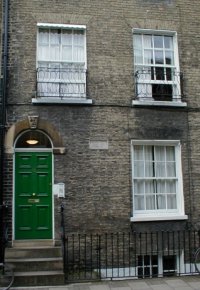
Darwin graduated in the Easter Term of 1831. Although he later recalled that: "During the three years which I spent at Cambridge my time was wasted, as far as the academical studies were concerned." It is certainly the case that Darwin became irreversibly devoted to science at Cambridge. His beetles were more than a hobby and his biological work under his mentor, Professor John Stevens Henslow (1796-1861), prepared him for a life in science. Shortly afterwards he was taught the rudiments of geology by Professor Adam Sedgwick (1785-1873). It was Henslow who passed on the invitation to Darwin to accompany Captain Robert Fitzroy (1805-1865) on board the voyage of HMS Beagle as naturalist and gentleman companion.
Upon returning from the five-year voyage in 1836 Darwin returned to Cambridge to sort out his specimens for three months. He took lodgings in Fitzwilliam Street (today marked by a stone plaque). He dined often in college and regaled the fellows with tales of cannibals and his adventures. Arthur Shipley wrote in the College Magazine in 1909:
[Darwin] was apparently a good deal in college, and was evidently made a "Member of the Room," for his name occurs frequently in the Combination Room wine book. This book, which dates back to pre-Napoleonic times, is one of the few records the college retains of the presence of the great naturalist.
Darwin moved to London in 1837 to begin his life of publishing the results of his voyage, both geological and biological.
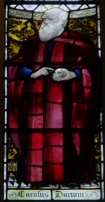
His great work On the Origin of Species (1859) demonstrated with converging evidence from geographical distribution, comparative anatomy and embryology, and the fossil record that life evolves. His theory showed how the great variety of living things are related by common genealogical descent and how all living things come to be exquisitely adapted to their environments. The most important mechanism for change was what he called 'natural selection'. This process is the necessary result of the fact that all organisms vary and are not identical copies and vastly more individuals are born than ultimately survive to breed. Therefore only a tiny minority survives to reproduce. Darwin realized that there must be something special about these surviving minorities. The success in surviving was termed selection because it was analogous to the conscious selection of farmers and breeders of which stock to perpetuate. In later works such as The Descent of Man (1871) and The Expression of the Emotions (1872), Darwin showed that there is not an absolute difference of kind between humans and other animals, but one of degree. Although controversial at first, Darwin's work was accepted by the vast majority of naturalists during his lifetime.
Later Darwin sent his eldest son William to Christ's in the 1860s. On 17 November 1877 Darwin was awarded an honorary degree of Doctor of Laws (LL.D.) from the University of Cambridge in Senate House. Darwin died in 1882 and is buried in Westminster Abbey.
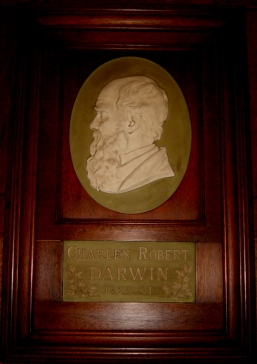
This Wedgwood plaque by Thomas Woolner was placed
in Darwin's room in 1885 by his son George Darwin.
In 1909, the centenary of Darwin's birth and the fiftieth anniversary of the publication of the Origin of Species, celebrations were held at Christ's and the University. Darwin's rooms were made into an exhibition space with many photographs, manuscripts and other artifacts on display. Hundreds of distinguished visitors from around the world came to see the exhibition and signed their names in a book now kept in the Old Library. An American delegation presented the college with a large bronze bust of Darwin made by the sculptor William Couper for the New York Academy of Sciences in the same year. The first bust was given to the American Museum of Natural History who commissioned a copy from Couper to send to Cambridge. The bust now stands in the portico in the college grounds.
Arthur Shipley remarked in a speech at the time: "His relations to Christ's were always of the most cordial kind, and it has ever been a subject of regret to the governing body that their new statutes did not pass through Parliament in time for them to confer the only honour they could confer upon Darwin, that of an honorary Fellowship." Darwin himself recollected in his autobiography written in 1876 "Upon the whole, the three years I spent at Cambridge were the most joyful of my happy life."
The Complete Work of Charles Darwin Online
A Darwin manuscript discovered at Christ's College after a century in darkness
by John van Wyhe, Bye-Fellow
A Darwin manuscript has been discovered at Christ's College that had been hidden since 1909.

For many years a framed photograph of Charles Darwin (1809-1882) hung on the end of a book case in the Old Library. Also inside the frame, just below the photograph, a small rectangular opening in the mount diplayed the signature 'Ch. Darwin'. During recent visits to the Old Library I was curious to know if this
signature was just a scrap of paper cut from a letter, or if it was written on a document still preserved, though sealed inside the frame.
The photograph, and the frame, have their own story. A penciled note on the wooden back of the frame explains:
This photograph of Darwin was presented by him to my Uncle, F.D. Dyster, of Tenby. I am informed by Francis Darwin, his son, that the photograph was probably taken in the year 1854, but he had never seen it. F. H. H. Guillemard.
Below this it is explained that it was displayed at Christ's during the Darwin centenary exhibition in 1909.
Finally a typewritten note records that Guillemard gave the framed photograph to the College in 1934.
There is an entry for the photograph in the 1909 exhibition catalogue.
91. PORTRAIT OF CHARLES DARWIN.
Lent by Dr. F. H. H. Guillemard.
Photograph probably taken about 1854 and given by Charles Darwin to F. D. Dyster, Esq., the microscopist.
(Shipley, Darwin Centenary. The portraits, prints and writings of Charles Robert Darwin. Exhibited at Christ's College, Cambridge, 1909.)
This photograph was taken about one year after Darwin started full-time work on his species theory, c. 1855 by Maull and Polyblank for the Literary and Scientific Portrait Club. A Darwin letter to J. D. Hooker on 27 May 1855 refers to this photograph: 'if I really have as bad an expression, as my photograph gives me, how I
can have one single friend is surprising.' (Correspondence of Charles Darwin, vol. 5, p. 339.)
There is no known surviving Darwin correspondence with Frederick Daniel Dyster (1810-1893). He was a surgeon naturalist with strong interests in marine zoology. Dyster was a friend of T. H. Huxley and attended Emma Darwin's aunt, Jessie Sismondi, when she died on 3 March 1853. (Litchfield, H. E. ed. 1915. Emma Darwin, A century of family letters, 1702-1896. London: John Murray. Volume 2, p. 152)
The College Librarian, Candace Guite, and the Keeper of Pictures, David Norman, gave permission for the frame to be removed and opened. This was done by Conservation Officer, Melvin Jefferson.
On opening the frame, which had presumably been sealed since 1909, Jefferson found the Darwin signature to be the endorsement on the back of a cheque! The entire cheque had been carefully folded and preserved so that just the signature on the back could be seen through the mount.
The cheque is from the Union Bank of London, made out by Darwin 'to self' for 100 pounds on 21 March 1872!

Photo by Melvin Jefferson.
The entire cheque transcribed is as follows (Darwin's writing is in bold):
No. V18356 London March 21 1872
The Union Bank of London,
CHARING CROSS BRANCH 4, PALL MALL EAST.
Pay to self or Order One Hundred Pounds100.0.0
This Cheque must be endorsed by the party to whom it is payable
Ch. Darwin
On the reverse it is signed: 'Ch. Darwin' – this being the signature visible under the framed photograph.
The cheque is stamped: 'Paid Mar. 22' A hole in the centre probably indicates Darwin put the cheque on his spits.
What was Darwin doing on 21 March 1872? We know from his 'Journal' or diary that he and his family left their rented London holiday house on that very day to return to their home in the village of Downe, Kent.
'Feb. 13 to March 21. London, 9 Devonshire St. Portland Place (5 weeks)'.
According to the Calendar of his correspondence, Darwin acknowledged payment from his American publisher on the 16th. American editions of Darwin's new book, The descent of man, had been in print since 1871.
So how did the cheque end up inside the frame with the photograph Darwin gave to Dyster? Dyster's nephew, Dr Francis Henry Hill Guillemard (1852-1933), a geographer and travel writer, signed the exhibition guest book at Christ's College with Francis Darwin on 11 June 1909. Perhaps Francis Darwin offered the cheque from his father's papers as an example of his signature. Darwin's papers had now become so precious that the cheque was preserved, and the signature not just cut out.
And so the photograph, and the cheque bearing Darwin's signature, were sealed behind glass in 1909. In 1934 the frame was given to Christ's (probably after the death of Guillemard) where it has hung ever since.
Both the photograph and the cheque will now be conserved according to modern standards.
To find out more about Darwin see: The Complete Work of Charles Darwin Online.
Christ's College is relatively small and cannot easily accommodate visits by large groups. In view of this we specify that groups should be no larger than 12 including any guides. In some circumstances, larger groups can be accepted by arrangement, but this normally involves dividing the visitors into groups of 12, and staggering their times of arrival at College.
Organisers of visits who wish to bring a group to Christ's are asked to note the College's opening times before making any arrangements. All group visits to the College should be arranged through Cantab Tours, who will provide an official Cambridge Blue or Green Badge Guide. If you are thinking of organising a group visit to Christ's please contact the Director of College Services in the first instance.
Getting to Christ's College
Christ's College Sports Ground (shared site with St Catharine's College)
University of Cambridge Official Map.

By Bicycle
The best way to get around Cambridge is by bicycle. Plan a cycle journey here with CycleStreets.
By Rail
There are direct services from London Kings Cross and London Liverpool Street. When travelling from the north or west, it is normally necessary to change at Peterborough and/or Ely.
There are frequent bus services from Cambridge Railway Station to the city centre (Drummer Street Bus Station, which is adjacent to the College); taxis are also available at the station.
By Bus
Drummer Street bus station is a 2 minute walk from the College. There are frequent buses two and from the railway station.
The Universal bus service links Eddington with West Cambridge, the city centre (Queens College/Silver Street), the railway station and the Cambridge Biomedical Campus (including Addenbrooke's), and runs every 15 minutes Monday to Friday and every 20 to 30 minutes at weekends.
By Coach
National Express long distance coach services terminate at Parkside, on the Northern side of Parkers Piece, as does the Stagecoach X5 service from Oxford via Milton Keynes. Christ's is only a few minutes walk from the terminal.
By Air
There are direct coach services from the four London airports: Heathrow, Gatwick, Stansted, and Luton. There is also a direct train service from Stansted (which is the nearest of the four London airports).
By Road
Parking in Cambridge city centre car parks can be difficult and is also expensive.There are several Park and Ride sites located outside the city centre with bus connections to Drummer Street Bus Station, adjacent to the College, and it is recommended that visitors use these facilities whenever possible. Details of Park and Ride sites, city centre car parks and parking charges can be found on the City Council's website.
The College has very limited on-site parking facilities, which are invariably full to capacity in term. The College car park may only be used by visitors with the permission of the Director of College Services. Please note that car parking is not available for bed and breakfast guests.
Road approaches to Cambridge can be seen here
The College main gate and Porters' Lodge are located on St Andrew's Street.
Please note that there is a one way system in operation preventing direct access to St Andrew's Street from Regent Street: private vehicles heading North up Regent Street are directed right into Park Terrace, left into Parkside / Drummer Street and then left again into Emmanuel Street. At the end of Emmanuel Street, turn right into St Andrew's Street and Hobson's Street for the College.
Please also note that Hobson's Street is one way, with no entry permitted from the King Street end, so it is not possible to access the College car park from King Street. Satellite navigation systems are not always aware of this restriction.
A representational map showing the layout of the College, with staircases and public rooms identified.
The charity's mission is the advancement of education, religion, learning and research through the provision of a college within the University of Cambridge.
The College welcomes diversity amongst its students, academic and non-academic staff and visitors, recognising the particular contributions to the achievement of the College's mission that can be made by individuals from a wide range of backgrounds and experiences.
| John Syclyng | 1505 - 1506 | 1st Master |
| Richard Wyatt | 1506 - 1508 | 2nd Master |
| Thomas Thompson | 1508 - 1517 | 3rd Master |
| John Watson | 1517 - 1531 | 4th Master |
| Henry Lockwood | 1531 - 1548 | 5th Master |
| Richard Wilkes | 1548 - 1553 | 6th Master |
| Cuthbert Scot | 1553 - 1556 | 7th Master |
| William Tayler | 1556 - 1559 | 8th Master |
| Edward Hawford | 1559 - 1582 | 9th Master |
| Edmund Barwell | 1582 - 1609 | 10th Master |
| Valentine Cary | 1609 - 1622 | 11th Master |
| Thomas Bainbridge | 1622 - 1646 | 12th Master |
| Samuel Bolton | 1646 - 1654 | 13th Master |
| Ralph Cudworth | 1654 - 1688 | 14th Master |
| John Covel | 1688 - 1723 | 15th Master |
| William Towers | 1723 - 1745 | 16th Master |
| George Rooke | 1745 - 1754 | 17th Master |
| Hugh Thomas | 1754 - 1780 | 18th Master |
| John Barker | 1780 - 1808 | 19th Master |
| Thomas Browne | 1808 - 1814 | 20th Master |
| John Kaye | 1814 - 1830 | 21st Master |
| John Graham | 1830 - 1849 | 22nd Master |
| Joseph Shaw | 1849 | 23rd Master |
| James Cartmell | 1849 - 1881 | 24th Master |
| Charles Swainson | 1881 - 1887 | 25th Master |
| John Peile | 1887 - 1910 | 26th Master |
| Sir Arthur Shipley | 1910 - 1927 | 27th Master |
| Norman McLean | 1927 - 1936 | 28th Master |
| Sir Charles Darwin | 1936 - 1939 | 29th Master |
| Charles Raven | 1939 - 1950 | 30th Master |
| Brian Downs | 1950 - 1963 | 31st Master |
| The Lord Todd | 1963 - 1978 | 32nd Master |
| Sir John Plumb | 1978 - 1982 | 33rd Master |
| Sir Hans Kornberg | 1982 - 1995 | 34th Master |
| Alan Munro | 1995 - 2002 | 35th Master |
| Malcolm Bowie | 2002 - 2006 | 36th Master |
| Frank Kelly | 2006 - 2016 | 37th Master |
| Jane Stapleton | 2016 - 2022 | 38th Master |
| The Lord McDonald of Salford | 2022 | 39th Master |
Simon McDonald was born and educated in Salford, and read History at Pembroke College, Cambridge, where he is now an Honorary Fellow.
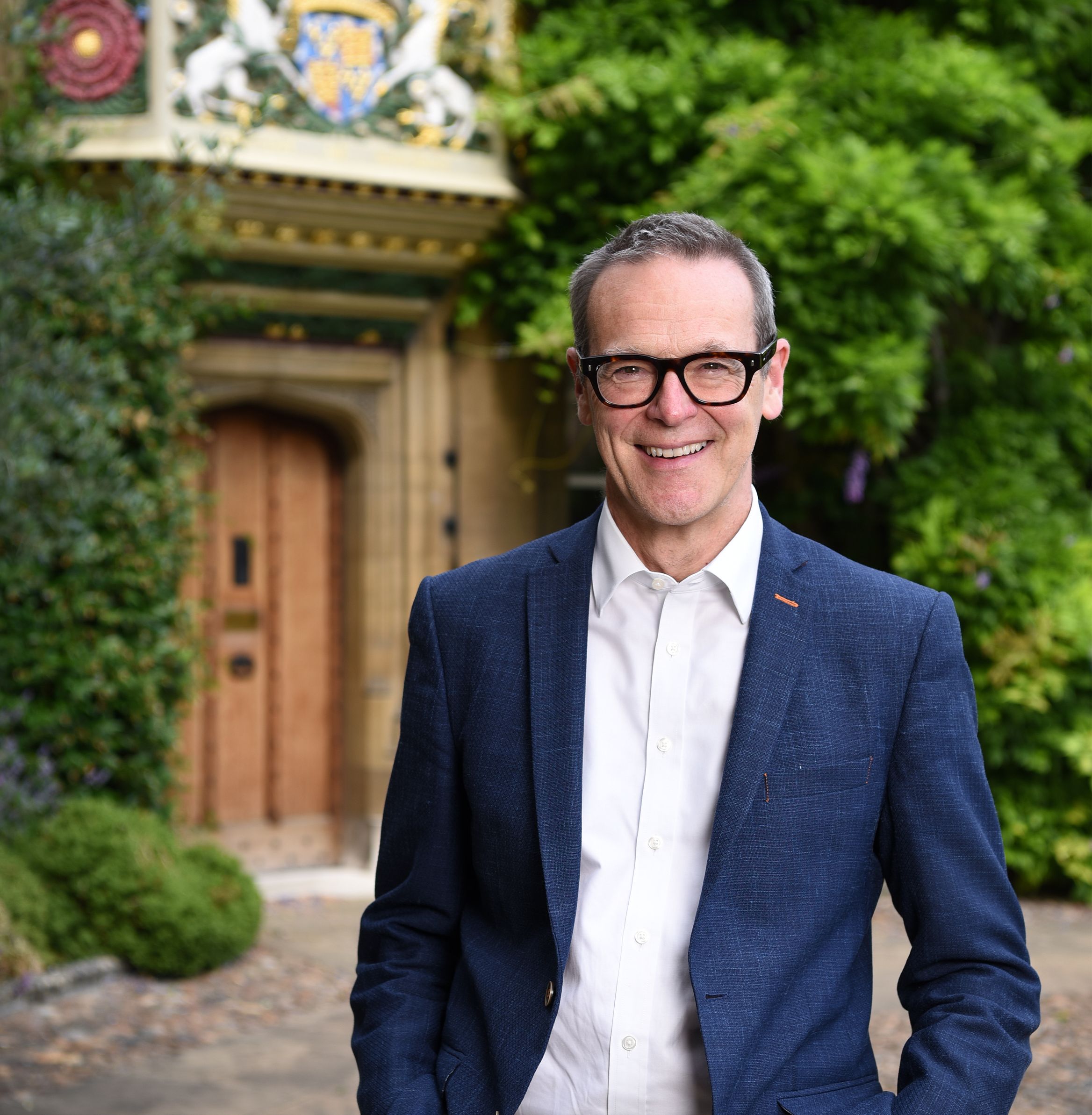
He joined the Foreign and Commonwealth Office (FCO) in 1982 and, early in his career, served in Jeddah, Riyadh, Bonn and Washington, D.C. He was British Ambassador to Israel (2003-2006) and to Germany (2010-15). In September 2015 Simon became Permanent Under-Secretary at the FCO and Head of the Diplomatic Service. After leaving the FCO in Autumn 2020, he was appointed a life peer, taking his seat in the House of Lords as Lord McDonald of Salford in February 2021.
Simon is a Knight Grand Cross of the Order of St Michael and St George (GCMG) and Knight Commander of the Royal Victorian Order (KCVO).
His first book - Leadership: Lessons from a Life in Diplomacy - was published in 2022 and his second - Beyond Britannia: Reshaping UK Foreign Policy - in 2023.
The University of Salford awarded him an Honorary doctorate in 2024.
Simon became the 39th Master of Christ's College on 1 September 2022. He is married to Olivia and they have four adult children.
Address: Christ's College, Cambridge CB2 3BU.
E-mail: masters-assistant@christs.cam.ac.uk
Visitors are welcome to explore the College and its grounds. Apart from the Chapel, visitors are not able to enter any College buildings. Please note that these details are subject to change at any time; in particular, the College or the Fellows' Garden are sometimes closed for functions and other events.
PLEASE NOTE: The College may be closed to visitors at short notice.
Opening Times:
College Grounds 09.00-12.00, 7 days a week
Fellows' Garden 09.00-12.00, Monday to Friday
Visitors are also welcome to attend the Choral Evensong services held in the College Chapel - these occur during term, on Thursdays at 6.45pm and on Sundays at 6pm. See the Chapel pages for more details.
The College is open all year round, except during the Christmas close down and during the Quiet Period. During the Quiet Period, prior to and during the University examinations, the College is closed to all visitors, including other members of the University, unless they are on College business. The exact dates of the Quiet Period vary from year to year, according to term dates but as a rough guide, the Quiet Period runs from early May to the end of June.
For further information about visiting, please see: