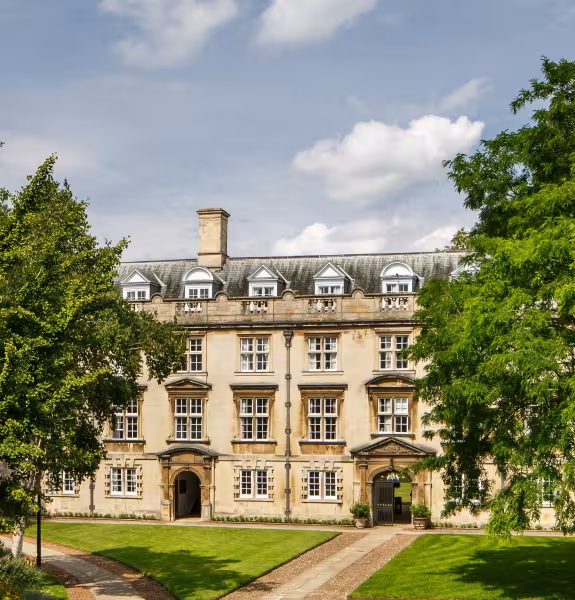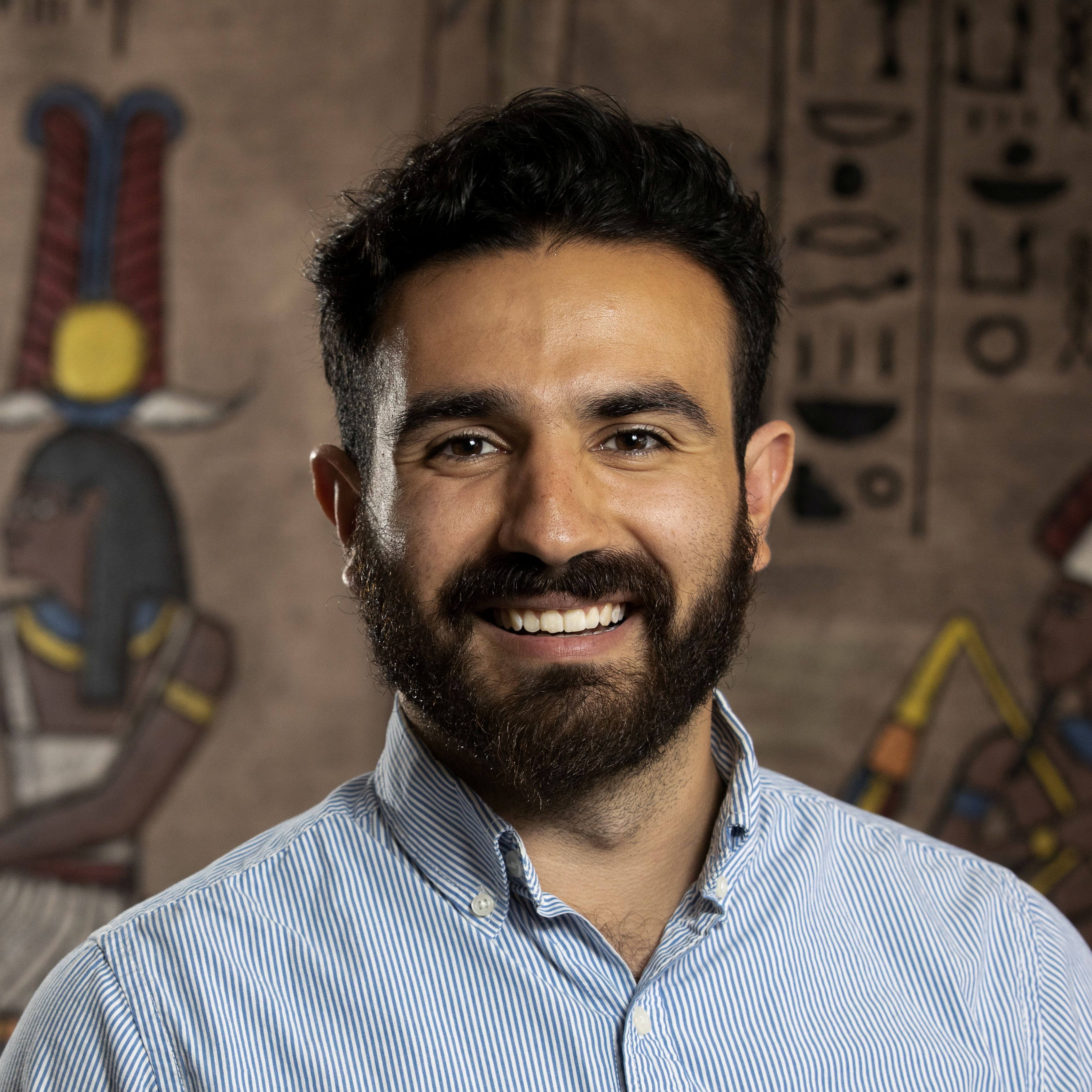
Dr Jason Silvestri is the Lady Wallis Budge Junior Research Fellow in Egyptology at Christ’s. Originally hailing from Massachusetts (USA), he received an honors BA from the University of Toronto (University College), with a specialization in Ancient Near and Middle Eastern Civilizations. He completed an MA in Near Eastern Studies, prior to receiving his PhD in Egyptian Art and Archaeology in 2026, both at the University of California, Berkeley.
Jason's work sits at the intersections of political anthropology, Amazigh studies, archaeology, and Egyptology. It examines the ways in which the poorly understood Ancient Libyan groups interacted with Egyptian society in the broader 2nd and 1st millennia BCE. His historical and archaeological work focuses on complicating our understanding of Egyptian society during the Libyan Period (Dyns. XXI-XXIV; ca. 1070-720 BCE). The Libyan Period is contemporary with the Early Iron Age elsewhere in the greater Mediterranean and Southwest Asian worlds and, in Egypt, constitutes a period long understood to be marked by the weakening of centralized state control and a proliferation of regional and non-state modes of authority, often held to be the product of Libyan cultural influence. His current book-project, entitled Violent Priests, Pious Warlords, and Libyan Elders, utilizes his own critical re-translation of over 220 textual primary sources to propose a new framework for understanding the nature and entanglement of non-state socio-political logics during the Libyan Period. He determines that there were three fundamental social logics active during the period that legitimated the formation of new political structures: social consensus, particularly held among smaller-scale local communities and temple priesthoods; violent coercion, commonly imposed by an emergent warlord class, though also deployed by priests during the period’s frequent priestly blood feuds; and loyalty, an inheritable series of social and economic obligations which were passed down in diasporic Libyan families resident within Egypt already, at that point, for centuries.
Jason is also a field archaeologist, having worked on several excavations, both in Egypt and across the Mediterranean in Greece and Italy. His current archaeological work is designed to test how the material culture and settlement remains of Libyan Period occupations may complicate the social models he has derived from textual study. Jason co-directs the el-Hibeh Project, an archaeological mission to the site of el-Hibeh, in Beni Suef Governorate (Arab Republic of Egypt). His work on the el-Hibeh Project is focused on the often-overlooked settlement contexts of Libyan Period date. He aims to provide fresh and interdisciplinary archaeological perspectives, drawn from collaboration with an international team of specialists in bio-archaeology (human osteology, zooarchaeology, paleobotany, etc.), ceramics, earthen architecture, textile production, Egyptological epigraphy, papyrology, and other related disciplines, so that the distributions of commodities and production centers found at the site can be compared against his textually derived models for Libyan Period political economy.
Trained in Amazigh Studies alongside Egyptology, Jason also works on the linguistics of ancient languages belonging to the broader ‘Berber’ branch of the Afro-Asiatic language superfamily. Since 2024, he has identified the so-called ‘Qeheq Papyrus’ (pQeheq = pTurin Cat. 2106/380 = CGT 54030) as the oldest (ca. 13th-12th cent. BCE) datable testimony of a (para-)Berber language, namely the Ancient Libyan Qeheq language, pushing the secure dating of the ‘Berber’ branch of Afro-Asiatic back by just over a millennium. His linguistic work provides yet another complementary approach to the study of Libyan-Egyptian social interaction and constitutes one of the few bridges between Egyptology and the study of the various regions of ‘Ancient Libya,’ west of the Nile. When not reading dusty ancient inscriptions and digging around the Mediterranean, Jason enjoys traveling, photography, hiking and all sorts of other outdoor activities, as well as trying his best in the kitchen to replicate the many cuisines of the places he’s worked and lived.
Selected Publications:
Silvestri, Jason. 2024. “The Oldest Berber Text(s)?: Egyptian Evidence for the Ancient Libyan Language(s)” Études et Documents Berbères 49-50.
Photo credit: Matthew Gush