
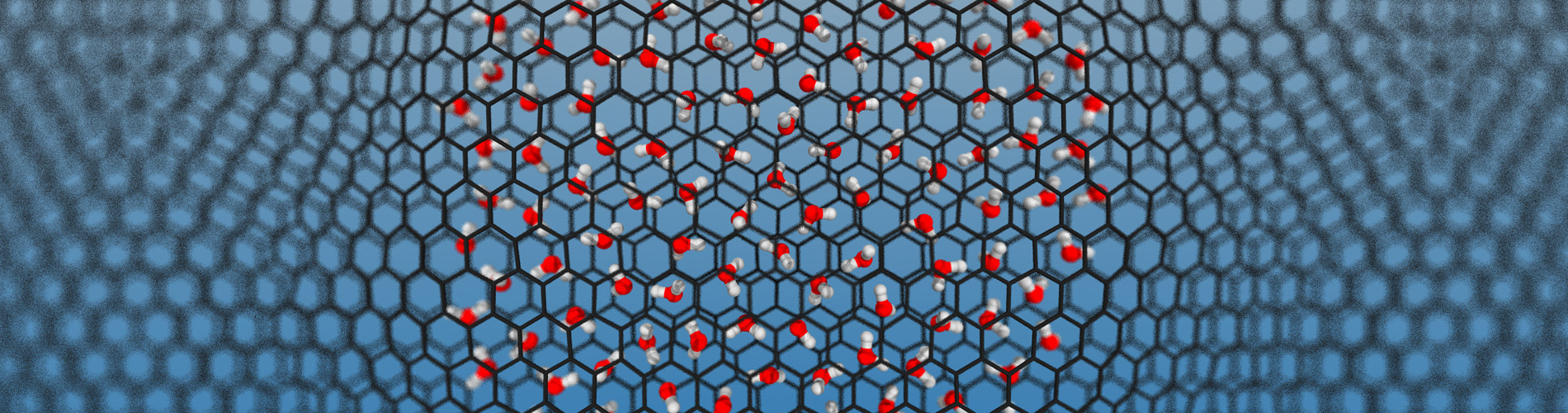
Researchers, including Dr Christoph Schran (Fellow) and Dr Chuck Witt (former Junior Research Fellow), have resolved a long-standing debate about how water behaves when confined to spaces just a few molecules wide.
They have shown that the chemistry of nanoconfined water is governed less by confinement itself than by pressure and the nature of the surrounding material.

The research could prove particularly valuable for technologies that rely on confined water, including hydrogen fuel cells, batteries, ion-selective membranes, and catalytic systems.
Dr Schran said:
“This research provides a new framework for understanding water chemistry at the nanoscale and helps reconcile a decade of apparently conflicting studies.”
The researchers from Cambridge, Harvard, CalTech, and the Max-Planck Institute for Polymer Research used machine-learning-based simulations capable of reproducing quantum-mechanical accuracy to explore a much wider range of conditions than conventional computational approaches allow.
They found that the apparent reactivity of nanoconfined water is extraordinarily sensitive to conditions such as density, pore width, wall flexibility, and surface chemistry.
Although confinement does not intrinsically alter water reactivity, the confining material can enhance reactivity through a specific mechanism.
Importantly, this effect was absent in graphene, whose chemically inert surface does not participate in the reaction. The finding demonstrates that the confining material itself can actively influence water chemistry.
Dr Schran said:
“More importantly, the work offers a practical design principle for engineering nanoscale chemical environments. Rather than focusing solely on the size of pores or channels, we can tailor water reactivity by choosing a confining material whose surfaces interact with the products of water dissociation and by controlling the pressures generated within confined spaces.”
Read more: Cavendish Laboratory Department of Physics
Advincula, X.R., Litman, Y., Fong, K.D., Witt, W.C., Schran, C., Michaelides, A. ‘How reactive is water at the nanoscale and how to control it?’ Science Advances DOI: 10.1126/sciadv.aeb5772
Banner Image credit: Xavier Rosas Advincula